



For the past several years, Johnson City and the Tri-Cities have been magnets for people looking to relocate.
Affordable housing, a slower pace of life, access to the outdoors, and a strong sense of community have attracted new residents from across the country. And while Tennessee remains one of the nation’s most popular destinations for people moving in, the latest numbers suggest that the relocation boom is beginning to cool.
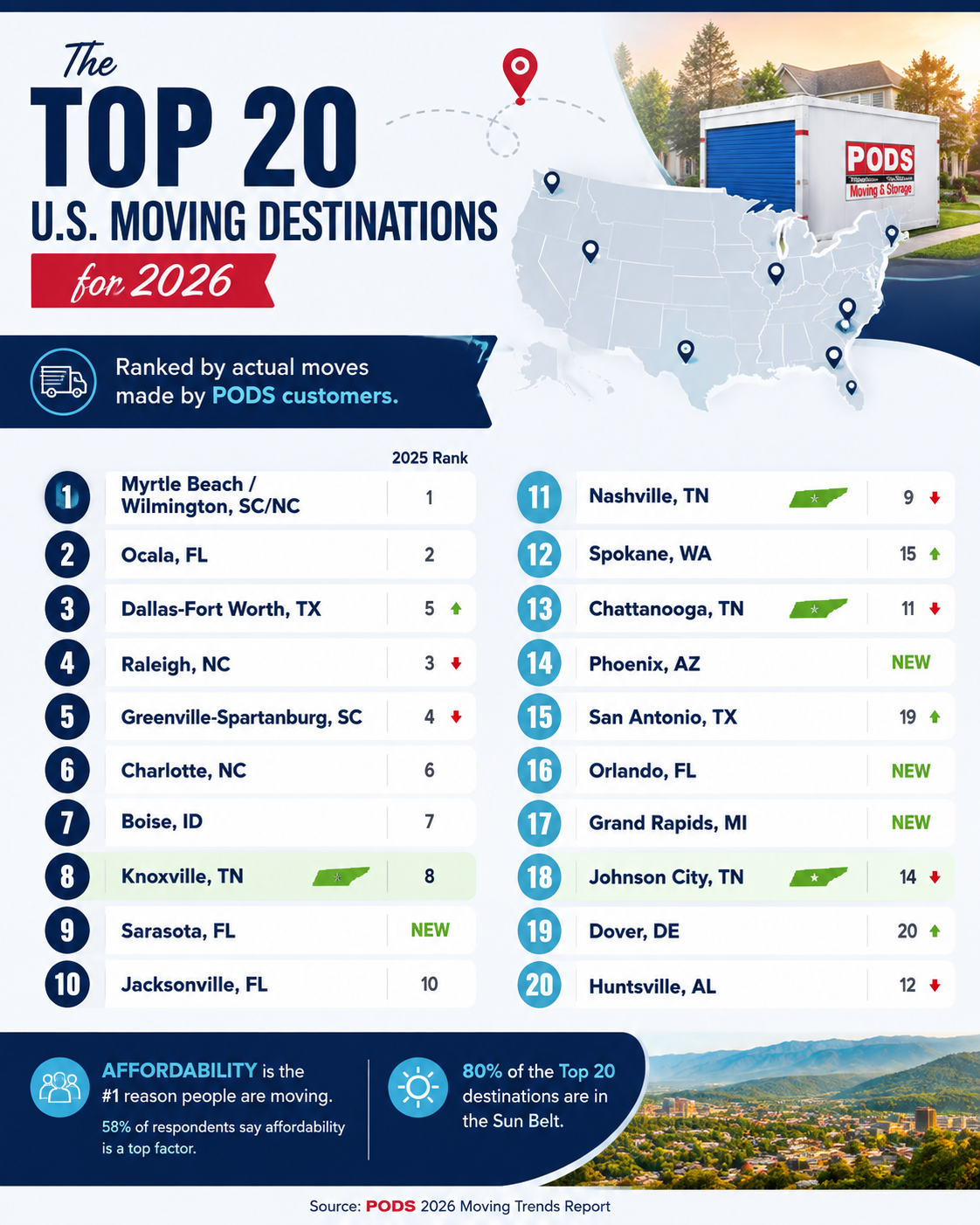
According to the 2026 PODS Moving Trends Report, Tennessee tied Florida for the No. 1 move-in state in the country. But several Tennessee cities slipped in the rankings, including Johnson City.
Johnson City Drops in the National Rankings
Johnson City was once at the top of Tennessee's relocation list. In 2025, it ranked No. 14 nationally among the cities attracting the most new residents.
This year, Johnson City fell four spots to No. 18.
Other major Tennessee cities also saw their rankings decline:
- Knoxville: No. 8, unchanged
- Nashville: No. 11, down from No. 9
- Chattanooga: No. 13, down from No. 11
- Johnson City: No. 18, down from No. 14
Memphis also appeared on the national move-out list for the first time, ranking No. 20.
That doesn't mean people have stopped moving to Tennessee. Far from it. Instead, it appears the massive relocation surge we've experienced in recent years is beginning to level off.
And that may actually be a sign of a maturing market rather than a problem.
Affordability Is Becoming More Important Than Jobs
One of the most interesting findings in the latest relocation data is why people are moving.
Affordability was the No. 1 reason, with 58% of movers identifying it as a major factor. Community and connection came in second at 41%.
A job opportunity, meanwhile, was cited by just 28% of movers.
That's an important shift.
People aren't necessarily moving simply because they found a better-paying job somewhere else. Increasingly, they're looking for a place where their money goes further and where they can build a life.
Nearly half of the people surveyed said they would even turn down a higher-paying job if taking it meant moving away from their support network.
That's particularly good news for the Tri-Cities.
Why the Tri-Cities Still Has an Advantage
When people compare communities, housing affordability can be one of the biggest deciding factors.
According to Zonda's domestic migration analysis, the housing markets attracting the most domestic migrants tend to have home prices at or below roughly $400,000. Once prices move significantly above that level, the pool of potential buyers begins to shrink.
The Tri-Cities remains comfortably below that threshold.
The region's mid-year 2026 median home price was just over $300,000, making the Tri-Cities the least expensive of the major East Tennessee metro areas.
That price difference matters.
Someone selling a home in a more expensive market may be able to sell their existing property and purchase a home in Johnson City, Kingsport, Bristol, Jonesborough, or the surrounding communities while potentially having money left over.
That affordability continues to give Northeast Tennessee a competitive advantage.
Who Is Moving Here?
Another interesting part of the data is who is moving.
Baby boomers are increasingly looking toward the Carolinas and the Southeast, while Gen X and millennials are also showing strong interest in Southern states such as Tennessee, Florida, and Texas.
In fact, millennials and Gen X account for more than 60% of one-way moves tracked in the latest data.
That creates an interesting opportunity for the Tri-Cities because Tennessee continues to appeal to these generations.
The region also offers something that many larger cities struggle to provide: relatively affordable housing combined with outdoor recreation, smaller communities, healthcare, restaurants, universities, and easy access to the mountains.
Johnson City also has the advantage of being a college town, which gives it a somewhat younger population than some surrounding communities.
Why New Residents Matter So Much to the Tri-Cities
Migration isn't just important for the real estate market. It's important for the region's overall population.
The Tri-Cities experiences what's known as a natural population decrease, meaning more people die each year than are born.
That means the region depends heavily on people moving here to maintain and grow its population.
Think of it this way: the Tri-Cities needs a little more than 10 new residents every day just to offset the natural population decline.
Anyone who moves here beyond that number contributes to population growth.
So while the relocation boom may be slowing, continued in-migration remains extremely important.
And so far, much of that growth has been concentrated around Johnson City and Jonesborough.
What Does This Mean for Johnson City Real Estate?
The big takeaway isn't that people have stopped moving to Johnson City.
It's that the market is becoming more competitive for attracting those new residents.
Affordability is now more important than ever. People have more choices, and they're paying closer attention to what their money can buy.
That puts the Tri-Cities in a pretty good position.
We're still relatively affordable compared with many parts of the country, and we offer the combination of community, quality of life, outdoor recreation, and access to larger cities that many relocating buyers are looking for.
The days of seemingly endless migration may be behind us, but Johnson City still has a strong story to tell.
The relocation wave may be weakening — but the reasons people move to Northeast Tennessee haven't disappeared. And as long as we remain affordable, the Tri-Cities should continue to attract new residents looking for a place to call home.
Market data referenced from Don Fenley’s August 5, 2026 report, “Johnson City Is Still a New Resident Magnet, But the Pull is Weakening”
Check out this article next