



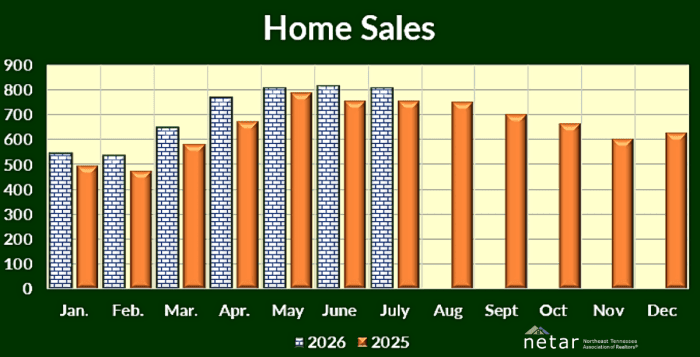
If you only looked at July compared with June, you might think the Tri-Cities housing market is starting to slow down.
Sales were relatively flat, and prices pulled back from June’s peak. But looking at the market through a year-over-year lens tells a different story.
Prices are up 1.05% from last year, while sales are up 5.9%. Inventory and new listings have made modest improvements, and homes are spending less time on the market before selling.
So, is the Tri-Cities housing market actually cooling?
Not necessarily. July appears to be more of a seasonal softening than a significant change in direction.
The market remains firmly in sellers’ territory, although the pace of growth is running slightly below what we saw before the pandemic.
Mortgage Rates Are Still Setting the Tone
One of the biggest factors influencing the market right now is mortgage rates.
The average mortgage rate in July was 6.49%, down from 6.72% a year earlier. That may not sound like a dramatic difference, but even a modest decline can make a meaningful difference for buyers—especially those shopping in the lower and middle price ranges.
Those buyers are typically more sensitive to monthly payment changes. When rates come down, even slightly, some buyers who had been sitting on the sidelines can afford to jump back into the market.
If rates remain around current levels—or move lower—we could continue to see solid demand for entry-level and mid-priced homes.
On the other hand, if rates move higher again, those buyers will probably feel the impact first.
Affordable Homes Led July's Growth
The strongest year-over-year growth came from the affordable segment.
Homes priced between $160,000 and $299,999 saw 338 sales in July, compared with 302 during the same month last year.
That's an 11.9% increase.
It makes sense that this segment would respond strongly to slightly lower mortgage rates. Buyers shopping in this price range tend to be particularly focused on affordability and monthly payment.
The increase also suggests there is still plenty of demand from buyers trying to make their first purchase or take that first step up the housing ladder.
The challenge?
There simply aren't enough lower-priced homes available to satisfy all of that demand.
Move-Up Buyers Are Still Active
The move-up market—which includes homes from $300,000 to $999,999—also posted healthy growth.
There were 349 sales in July, compared with 326 last July. That's a 7.1% increase.
This segment represents the largest portion of the market and covers a broad range of buyers.
Many move-up buyers are also sellers. They sell their existing home before purchasing another one, which means activity in this segment can help keep the entire housing market moving.
The fact that sales continued to increase tells us buyers aren't disappearing. They're adjusting to the current market and continuing to make moves when the right home comes along.
Luxury Sales Remained Steady
At the top end of the market, things were remarkably consistent.
There were 10 sales of homes priced at $1 million or more in July, exactly matching July 2025.
Luxury buyers tend to be less dependent on mortgage rates than buyers in the lower price ranges. Some pay cash, while others finance a smaller percentage of the purchase price.
That helps explain why the luxury market can behave somewhat differently from the rest of the Tri-Cities.
For July, the message was simple: steady, not explosive—and certainly not declining.
Where Were Buyers Actually Buying?
The heart of the Tri-Cities market continues to be the $200,000–$400,000 range.
Five price ranges accounted for more than three-quarters of all July sales, with the busiest categories being:
- $300,000–$399,999: 166 sales
- $200,000–$249,999: 134 sales
- $250,000–$299,999: 121 sales
- $500,000–$999,999: 100 sales
- $400,000–$499,999: 83 sales
The numbers tell an important story.
Buyers aren't evenly distributed across every price point. The largest concentration of activity remains in the middle of the market, where buyers are balancing what they want with what they can realistically afford.
The Market Is Moving Up the Price Ladder
One of the more interesting trends in July was the continued shift in where sales are occurring.
Fewer homes sold below $100,000 compared with last year.
That doesn't necessarily mean buyers suddenly stopped wanting inexpensive homes. In fact, demand for affordable housing remains strong.
Instead, it reflects two realities: home prices have risen, and the supply of the least expensive homes remains limited.
As home values increase, properties that once fell into the lowest price categories move into higher price ranges.
That helps explain why the affordable segment can show strong growth while the very lowest price points continue to shrink.
So, Is the Market Cooling?
The short answer is: a little—but probably not in the way you might think.
July brought some seasonal softening after June's stronger numbers. But when we compare July with the same month last year, the market is still showing growth.
Sales are up.
Prices are up.
Affordable-home sales are up nearly 12%.
Move-up sales are up more than 7%.
Luxury sales are holding steady.
Inventory and new listings have improved, although only modestly.
And homes are moving through the market somewhat faster.
Taken together, those numbers don't point toward a major market correction.
Instead, they suggest that the Tri-Cities housing market is normalizing while remaining relatively strong.
What Should Buyers and Sellers Expect This Fall?
For buyers, the biggest variable will continue to be mortgage rates.
If rates stay near current levels, demand—particularly in the affordable and mid-market ranges—should remain relatively healthy.
For sellers, the message is a little more nuanced.
This is still a sellers' market, but that doesn't mean every home will sell immediately or at any price.
Buyers are paying attention to value. Sellers who price appropriately and present their homes well should continue to benefit from solid demand. Those who overprice may find themselves making adjustments.
As we move toward fall, I don't expect a dramatic change in the overall direction of the Tri-Cities market.
Instead, the most likely scenario is more of the same: steady demand, strong activity in the middle of the market, continued pressure on affordable inventory, and a market that remains slightly below its pre-pandemic growth pace.
July may have looked like a slowdown on the surface.
But underneath the numbers, the Tri-Cities housing market is still moving forward.
Market data referenced from Don Fenley’s August 13, 2026 report, “Housing Market Softens, Remains on Solid Footing”
Check out this article next